
How to Use Chat Transcripts to Improve Your Product and Documentation
Chat transcripts are the only place customers describe your product in their own words at the moment they are confused. This guide covers the tagging taxonomy, the weekly triage loop, and how to turn recurring questions into documentation and roadmap items.

Stan
@stan
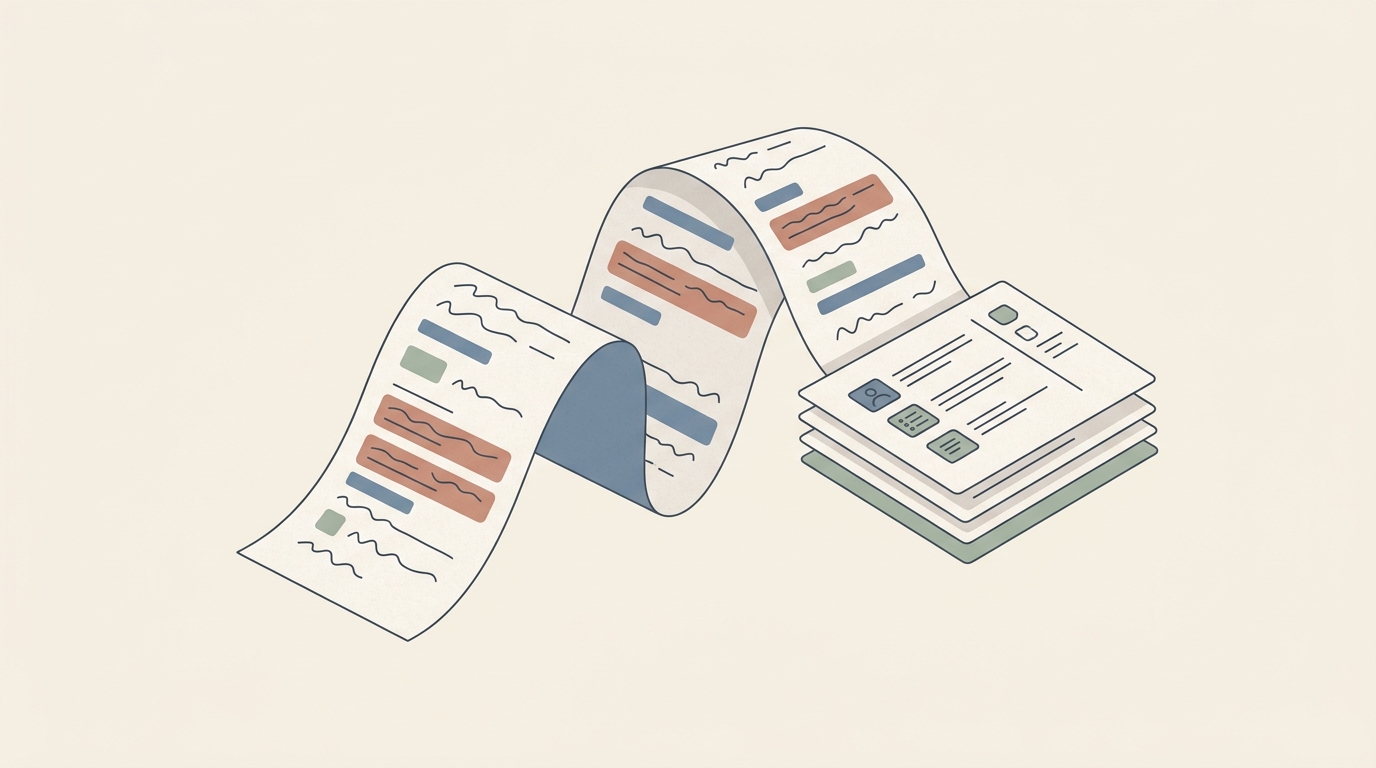
Most companies treat chat transcripts as an audit trail. They are stored in case of a dispute, occasionally sampled for quality scoring, and otherwise ignored.
That is a strange thing to do with the only dataset you have in which customers describe your product in their own words at the exact moment they are confused by it. Not in a survey written by your marketing team, not in a support ticket filtered through a template, but in the words they reached for when something did not work. Search logs come close, but they are three keywords long. Transcripts have the whole sentence and the follow-up.
This guide is about the workflow that turns that pile into two concrete outputs: documentation that removes questions, and product changes that remove the need for documentation.
The Economic Case, Stated Plainly
A repeated question has a unit cost, and where it gets answered determines that cost.
What One Resolution Costs, by Channel
Moving a repeated question from an assisted channel into documentation changes its unit cost by roughly an order of magnitude.
Source: Lorikeet, Cost Per Support Ticket benchmarks (2026), quoting per-channel resolution cost ranges. A separate benchmark in the same set puts self-service at $1.84 per contact against $13.50 for assisted channels.
The interesting number is not any single bar. It is the ratio. Answering something in a help article costs roughly a tenth of answering it on the phone, and a fifth to an eighth of answering it in an assisted chat. So the arithmetic on a question asked 40 times a month is straightforward: at $13 a contact it costs about $520 a month, and a documentation page that resolves it costs a few hours once.
That is only the first-order effect. The second-order effect is larger and harder to measure. A question asked 40 times a month is being asked by 40 people who found your product unclear, and behind them is a much larger group who did not ask.
The Silent Majority Problem
The classic finding in this area is that complaint volume massively understates problem volume. TARP's research in the 1990s, later popularised as the Lee Resource figure, found that for every customer who complains, roughly 26 do not. Separate work commissioned by the White House put the ratio at one voiced complaint per 27 dissatisfactions. Research from the Rockefeller Corporation attributes much of the silence to a belief that complaining is pointless: customers leave because they assume nobody is listening.
Apply that ratio to the transcript pile and the reading changes completely. A confusion that shows up in ten conversations this month is not a ten-person problem. It is a signal that something is unclear to a much larger population, most of whom silently worked around it, gave up, or churned.
This is exactly why transcripts are more valuable than tickets. A ticket requires a customer to decide their problem is worth filing. A chat message requires nothing but mild irritation and an open window, so the threshold for capture is far lower and the sample is far less biased towards the vocal.
Build a Taxonomy the Transcripts Give You
The instinct is to start with a category list derived from your product structure. It is the wrong direction, because your product structure is how you think about the product and the transcripts are how customers think about it. The gap between the two is itself a finding.
A workable taxonomy has four levels, an approach current voice of customer practice for B2B product teams converges on:
- Area. The broad surface: billing, onboarding, integrations, reporting.
- Feature. The specific thing: invoice download, SSO setup, CSV export.
- Behaviour. What the customer was trying to do or what went wrong: cannot find, does not work as expected, unclear pricing, missing capability.
- Segment. Who is asking: prospect, new customer, expanding account, at-risk account.
The fourth level does more work than it looks like it should. "Cannot find the export button" from a prospect is a marketing site problem. The same sentence from a three-year customer is a UI regression or a discovery problem, and it belongs in a different queue.
Derive the categories from a sample rather than inventing them. Read 100 conversations, cluster what you actually see, and name the clusters in the customers' language. Modern practice is to have a model do this first pass, reading a large sample, proposing clusters grounded in the real phrasing, and then applying the taxonomy consistently. Manual tagging stops scaling somewhere around 50 conversations a month, which almost every deployed chatbot exceeds in a week.
The Weekly Triage Loop
The single biggest determinant of whether this works is cadence. Quarterly synthesis produces a deck. Weekly triage produces changes.
Monday, 30 minutes. Pull last week's conversations. Filter to three buckets: conversations that escalated, conversations where the bot could not answer, and conversations with negative sentiment. Ignore the rest for now; they are working as intended.
Cluster by topic, not by volume. Five conversations about the same misunderstanding matter more than fifty about your shipping cutoff, because the shipping cutoff is a fact you can publish and the misunderstanding is a design problem.
Sort each cluster into one of four destinations. This is the step that turns reading into action, and every cluster gets exactly one:
| What the cluster shows | Destination | Typical fix |
|---|---|---|
| The answer exists but nobody found it | Documentation and bot corpus | Rewrite the page in the customer's phrasing, add the question as a heading |
| The answer does not exist anywhere | Documentation | Write it once, in one place, and link everything to it |
| The product does something confusing but correct | Product copy and UI | Rename a label, add inline help, reorder a flow |
| The product does the wrong thing, or lacks something | Roadmap | File it with the transcript attached |
Write one thing. Not a backlog of twelve. The largest cluster becomes one document or one ticket, this week. A loop that produces one shipped change per week beats a loop that produces a prioritised list of forty.
Measure the following week. Did that cluster shrink? If it did not, the fix addressed a symptom.
The Highest-Return Output: Customer-Language Documentation
There is a specific and repeatable pattern here that is worth naming, because it produces most of the value.
Your documentation says "deprovisioning a seat". Customers ask "how do I remove someone". Your help centre says "webhook endpoint configuration". Customers ask "how do I get it to tell my system when someone books". These pages exist, they are accurate, and they do not get found, because search and retrieval both work on similarity to what was typed.
Transcripts hand you the customer's phrasing for free. Three mechanical uses:
- Rewrite headings as questions in the customer's words. "Refund eligibility window" retrieves worse than "How long do I have to request a refund?". This is one of the cheapest accuracy gains available in a retrieval system, and a big part of why training data phrasing dominates model choice in real deployments.
- Add the customer vocabulary as synonyms in the body text. If half your customers say "package" and your docs say "plan", the word "package" needs to appear somewhere on the page.
- Create one document of the top 30 questions in verbatim customer language with two-sentence answers. This is consistently the single highest-value page in a knowledge base, and transcripts are where the verbatim comes from.
The same material feeds directly back into the bot. A question the bot could not answer this week becomes corpus next week, which is the mechanism behind the compounding improvement described in building an FAQ chatbot from existing documentation.
Reading Transcripts for Product Signal
Documentation absorbs the questions. Product changes remove them. Four patterns in transcripts reliably indicate that a fix belongs in the product rather than the docs.
The same feature explained repeatedly. If a capability needs an explanation every time it is encountered, the explanation is a patch over a design problem. Documentation demand is a proxy for interface failure.
Questions asked immediately after an action. "I clicked save, did it work?" means the confirmation state is too quiet. These are cheap fixes with outsized effect.
Workarounds described in the customer's own words. When several customers describe the same improvised process, you have found a missing feature that already has a validated design, because they designed it.
Requests phrased as assumptions. "Where do I set the reminder time?" from a customer who assumes a feature exists is stronger evidence than a feature request, because it reveals an expectation your product violated.
Attach the verbatim transcript to the ticket when filing any of these. A product manager reading "customers are confused by onboarding" will deprioritise it. The same person reading three customers describing the same confusion in their own words will not.
What to Watch Out For
A few failure modes are common enough to name.
Optimising for volume. The most frequent question is usually the easiest to answer and the least informative. The valuable clusters are mid-frequency and high-friction: asked ten times, took eight messages to resolve, ended in escalation. Sort by effort, not by count.
Tagging as an end in itself. A perfectly categorised backlog nobody acts on is a more expensive version of doing nothing. Cap the taxonomy at what you can act on and let a model handle the first pass so people spend their time deciding rather than labelling.
Treating the bot's failures as the bot's problem. A conversation where the bot could not answer is usually a content gap, sometimes a product gap, and only occasionally a retrieval bug. Diagnosing all three as "the AI is not good enough" wastes the signal entirely.
Privacy handled late. Transcripts contain personal data. Decide the retention period, the redaction rules for anything sensitive, and who can read them, before you build the workflow rather than after someone asks. If transcripts feed into any model or analytics tool, that has to be reflected in your privacy notice.
Instrumenting It
The workflow above needs very little tooling, but it needs the right few things.
- Every conversation stored with its outcome. Resolved by bot, escalated, abandoned. Without the outcome the sample is unfilterable.
- Escalation reason recorded. Which trigger fired matters, for the same reason it matters in escalation rule design.
- The retrieved passages logged with each bot answer. This is what distinguishes "we have no content on this" from "we have content and it did not surface".
- A tag field editable by humans. Model-proposed tags are a first pass and get overridden regularly.
- Search across transcript text. When someone asks whether a problem is real, you want to answer with twelve verbatim examples in the same meeting.
Analytics dashboards sit on top of this, and they answer a different class of question. The distinction is worth keeping clear: dashboards tell you the shape of the traffic, which is the subject of real-time conversation analytics, while transcript reading tells you what to change. Teams that only do the first end up with excellent charts about a product nobody fixed.
Where the Platform Fits
The practical obstacle is usually access rather than analysis. Transcripts live in one system, documentation in another, the bot's corpus in a third, and the loop dies at the seams. Paperchat keeps conversations, escalation state, and the chatbot's training sources in the same workspace, so the path from "the bot failed this question on Tuesday" to "the answer is in the corpus by Thursday" is short enough that people actually walk it. Short loops are the whole mechanism here; every extra hop is a place the habit stops.
The Bottom Line
Transcripts are the cheapest and least biased product research you will ever have, and their value decays with time, because a confusion you fix this month prevents next month's conversations.
Build the taxonomy from what customers actually say rather than from your feature list. Run a 30-minute weekly triage over escalations, failures, and negative sentiment, and route every cluster to exactly one of four destinations. Write one thing a week, in the customer's own words, and re-measure. File product tickets with the verbatim attached.
Then remember the ratio. Each cluster you are looking at represents a much larger group who never said anything at all, and the fix serves all of them.
More Articles
How Real-Time Conversation Analytics Help You Improve Customer Experience
Conversation analytics transforms every chatbot interaction into structured insight - here is how businesses use that data to close knowledge gaps, reduce escalations, and continuously improve customer experience.
April 12, 2026
How to Improve Your AI Chatbot's Accuracy with Better Training Data
When a chatbot gives wrong answers the instinct is to blame the model. Research and production experience both point upstream. This guide covers diagnosis, deduplication, chunking, metadata, and the measurement loop that actually moves accuracy.
July 22, 2026
How to Build an FAQ Chatbot from Your Existing Documentation
Your documentation already holds the answers, but it was written to be read, not retrieved. This guide covers the conversion, from finding the real questions to reshaping documents so a retrieval system can actually use them.
July 8, 2026